- Products
FLUX Erase: Remove anything, leave no trace

A stray person in a product shot. A cable cutting through a landscape. Text baked into a scene. These are the types of details that can break an otherwise usable image, and correcting them manually takes a lot of time.
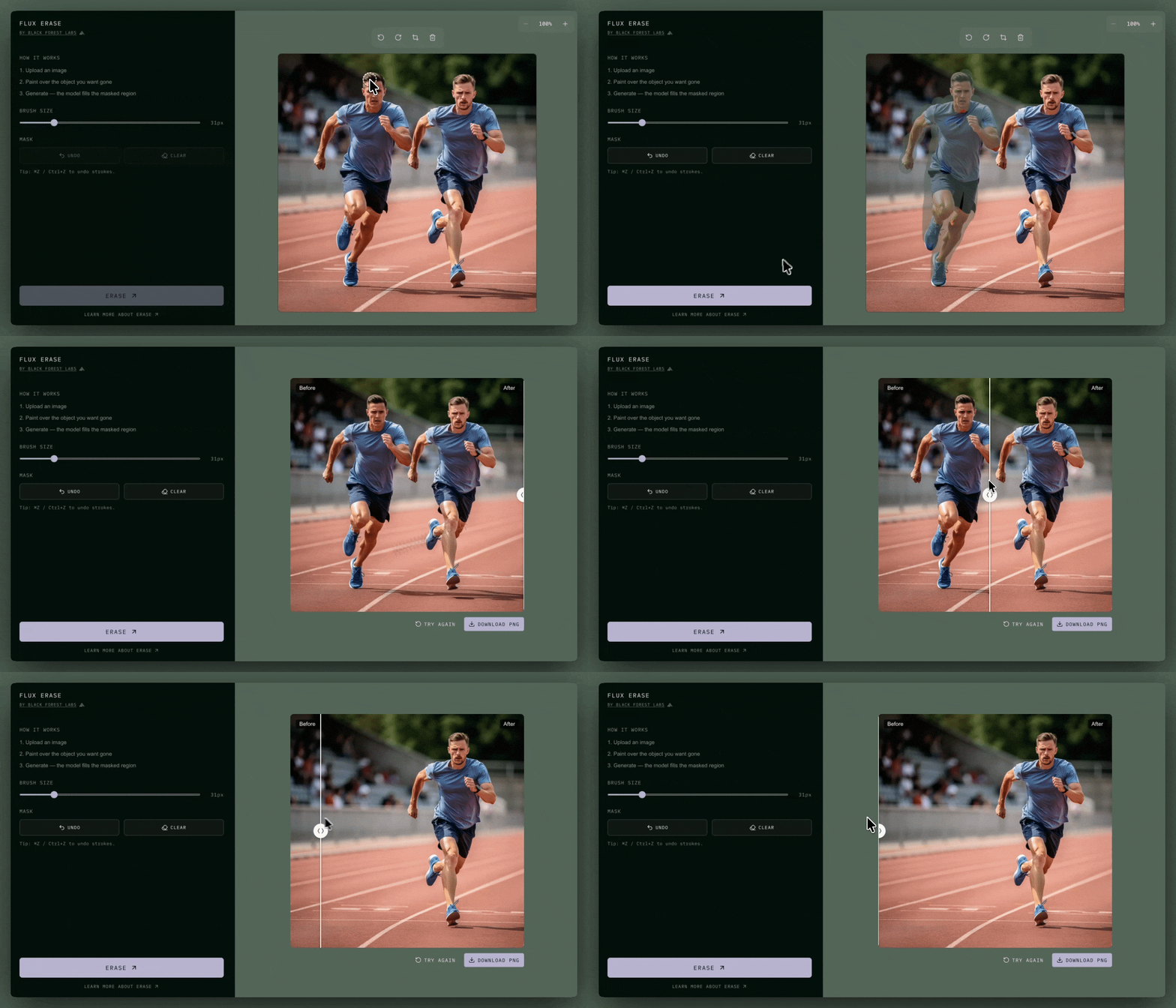
FLUX Erase removes whatever you mask - including its traces like shadows and subtle parts missed by the mask - and reconstructs the scene behind it coherently.
The problem with existing approaches
- Visible artifacts: most removal tools leave halos, smearing, or inconsistent texture at the edges of the removed area
- Incomplete reconstruction: the background fill is generated without understanding the full scene context, producing results that need manual correction
- Limited scope: tools trained narrowly on object removal struggle with text, people, watermarks, or compositionally complex scenes
FLUX Erase
Pass an image and a binary mask. The model erases whatever you've marked and reconstructs the scene behind it, matching lighting, texture, and background, no prompt required.
It works across objects, people, text, and anything else the mask defines. An optional edge expansion setting lets you expand the mask slightly for cleaner results on complex or soft-edged subjects.
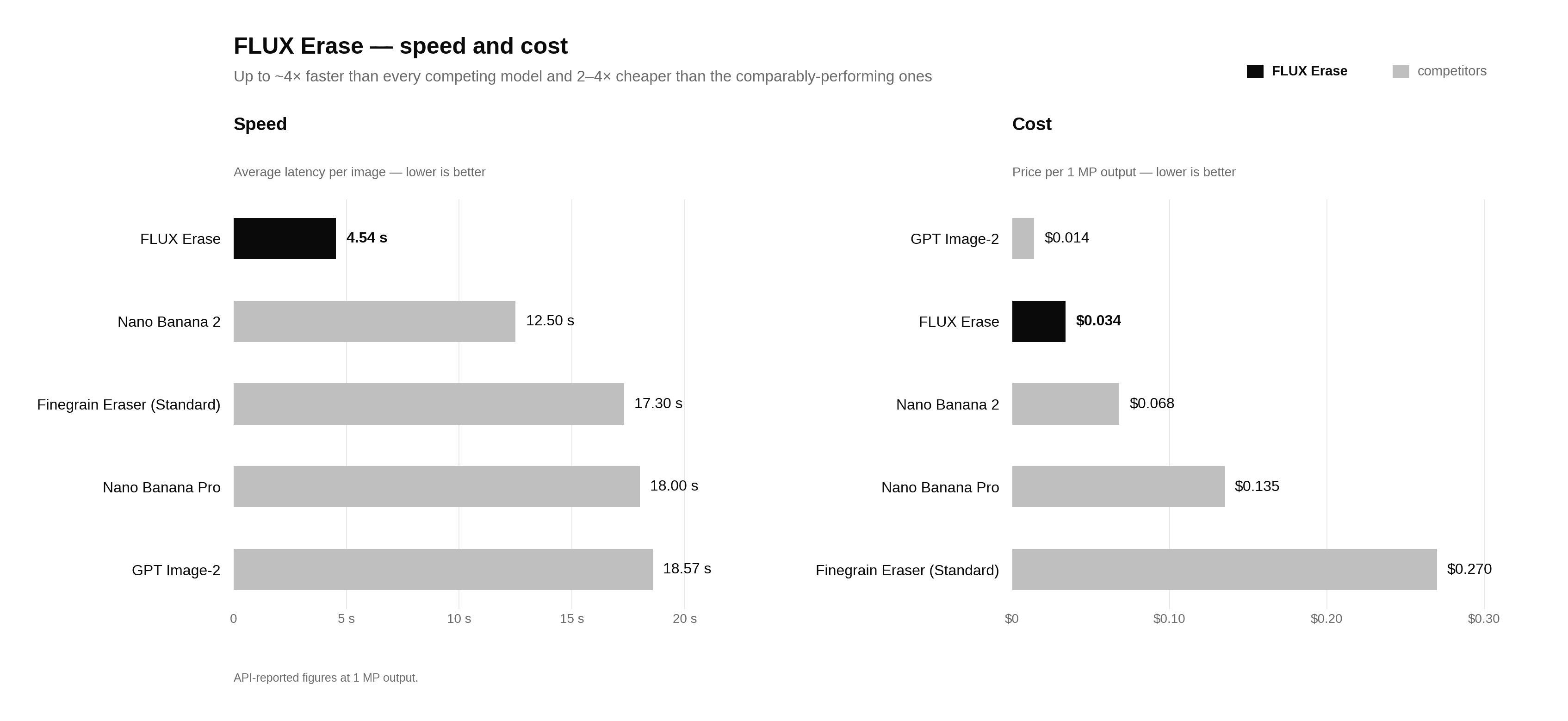
FLUX Erase matches the quality of frontier object-removal models at a fraction of the price and latency.
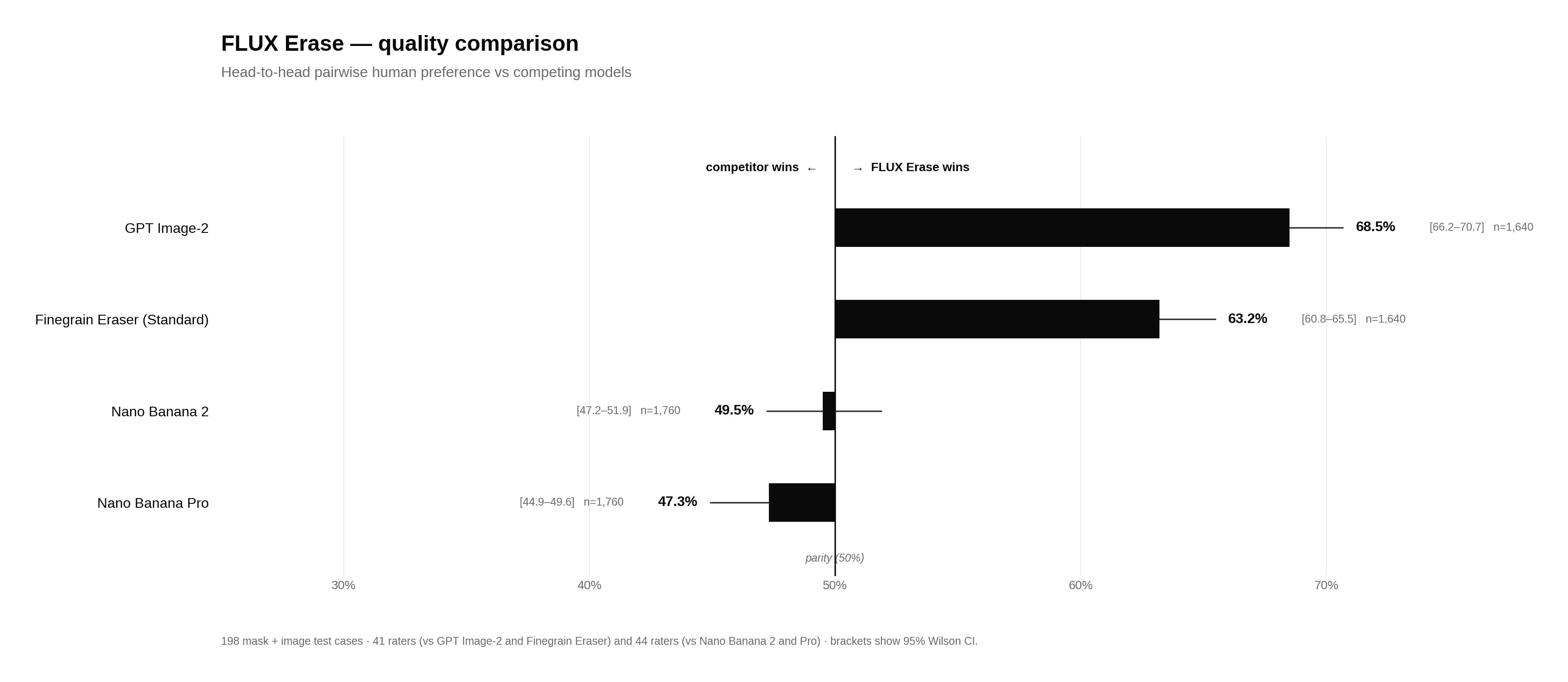
We evaluated FLUX Erase against other state-of-the-art models on a held-out benchmark of 198 mask-based object-removal test images. FLUX Erase wins decisively against GPT Image-2 (68.5%) and Finegrain Eraser Standard (63.2%), ties Nano Banana 2 (49.5%), and lands closely behind Nano Banana Pro (47.3%) - putting it on par with the current frontier of mask-based object-removal while running lightning fast and at a substantially lower cost.
Get access
FLUX Erase is available via the BFL API.